

 Eliminex pest Control Inc. is dedicated to environmentally responsible pest control practices. Our seasoned professionals use extreme caution around your family and property while insuring positive results. See More
 The commercial marketplace is where our pest control technicians experience and expertise shines through. Eliminex Pest Control technicians have the necessary knowledge, desire and pride to do the job right the first time!
 See More
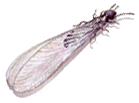 Our termite control division utilizes every tool necessary to eliminate termites from your house and property. By employing the latest baiting techniques we complete the job with little impact on the environment.
See More

Bed Bugs are back with a vengeance! It takes a professional company with extensive experience to eliminate these pests from your home. Eliminex Pest Control uses every tool at our disposal to rid your property of these annoying pests.
See More
Stored Product / Pantry Pests Biology and Control
Stored product pests can destroy large quantities of carbohydrate based foods!
Drugstore Beetle | Cigarette Beetle | Saw Toothed Grain Beetle
Red and Confused Flour Beetles | Spider Beetles | Rice Weevils
Indian Meal Moths | Angoumois Grain Moth | Contact Us
There are many stored product or pantry pests that infest all kinds of carbohydrate based products such as flour, cereal, grains and baking mixes. Also spices, nuts, processed foods, dried milk and cocoa powder can also become infested by these pests. The major orders of insects that affect these products are the beetles (coleoptera) and the moths (Lepidoptera) however there are many other insect pests that can become a problem in stored products. These two groups of insects both go through complete metamorphosis - egg, larvae (worm like), pupa (cocoon) and adult. Quite often you are searching for the larvae of these insects because that is where the food damage occurs. Eliminex Pest Control Inc. offers a variety of stored product control programs that includes one-time services with a guarantee or a maintenance plan that provides ongoing protection of your home or business.
Drugstore Beetle
Drugstore Beetles (Stegobium paniceum) and the Cigarette beetle and the Drugstore beetle are very often confused as they are similar in appearance, habits and biology. The most identifiable differentiating characteristic is that the drugstore beetle has longitudinal lines on their wings and the cigarette beetle does not. Drugstore beetles are small about one-tenth of an inch long, oval shaped and light to chestnut brown in color. The larvae are wormlike grubs and are white to cream in color. The larvae feed on almost anything of vegetable origin, including a great variety of stored foods, seeds, breakfast cereals and the like. True to their name, drugstore beetles feed on many drug components found in a pharmacy.
Cigarette Beetle
Cigarette Beetles (Lasioderma serricorne) are destructive to tobacco and tobacco products (especially those in storage).The larval stages of the cigarette beetle can also feed on a variety of stored products including dried yeast cakes, dried botanical specimens, dried fish, grain, cereal products, pet foods, rat and mouse baits, pasta, raisins, rice, dates, pepper, dried fish, drugs and seeds. Cigarette beetle adults are quite small, measuring about 2 to 3 mm (about 1/8 of an inch), and are reddish brown in color. The larvae are grub like and are a creamed color. The entire life cycle can be completed in 45-50 days, and there may be 3-6 overlapping generations per year in warmer climates, while one generation per year might be seen in more temperate locations.
Saw Toothed Grain Beetles
Sawtoothed grain beetle, Oryzaephilus surinamensis , is a widely distributed species commonly found in stored grain. It is often confused with a closely related species, the less common merchant grain beetle, Oryzaephilus mercator . Both the adults and the larvae feed on foods of vegetable origin, especially grain and grain based products such as flour, pasta products, cereals, dried dog foods, nuts, candies, dried fruits, yeast and tobacco. Adult Saw toothed grain beetles are tiny, brown, flat, slender, insects about 1/8 of an inch long with saw-tooth-like projections on each side of the thorax. Because of their flattened shape, Saw Toothed grain beetles are able to work their way into packages of food that are apparently tightly sealed. The of the larvae are whitish, elongated grubs with brown heads.
Red and Confused Flour Beetles
Red Flour Beetles (Tribolium castaneum) and Confused Flour Beetles (Tribolium confusum) These two beetles are often grouped together due to
the similarity in their appearance, biology, and behavior.The confused flour beetle and the red flour beetle are very similar in appearance and can be most easily distinguished by examining the antennae:
the antennae of the red flour beetle ends abruptly in a three-segmented club, while the confused flour beetle's antennae gradually enlarge towards the tip, ending in a four-segmented club. Larvae of both species are nearly indistinguishable.
They are a light honey color and about 6 mm (1/4”) long.
The head and a distinctive forked process at the tip of the
abdomen are slightly darkened.
They primarily infest processed or milled grain products, such as flour, cereal products, cake and pancake mixes, spices, powdered milk, chocolate, dried fruit and dry pet food. They cannot feed on whole
grain, but can feed on broken kernels. Fungi may also play an important role in the
nutritional requirements of flour beetles.
SpiderBeetles
Spider Beetles The American spider beetle (Mezium americanum) is about 3 mm in length. The body is dark reddish-brown to black, shiny, with a globular abdomen. They are a strange looking beetle and sometimes are mistaken for bed bugs. The larvae are “C” shaped and are cream colored with light brown heads. There are several species of spider beetles that infest stored products in the U.S. Spider beetles are scavengers in both the adult and the larval stage. Spider beetles infest warehouses, grain mills, museums, and homes. They feed on broken grain or grain products, seeds, dried fruits, wool, hair, feathers, insect and other animal remains, museum specimens, dried mushrooms, animal feeds and sugar.
Rice Weevil
Rice Weevils Sitophilus oryzae (Linnaeus)They are usually found in grain storage facilities or processing plants, infesting wheat, oats, rye, barley, rice, and corn. The most striking feature of the rice weevil is the long snout at the front of its head. The beetle varies from a dull red-brown to black, and is usually marked on the back with four light red to yellow spots. The rice weevil has fully developed wings beneath its wing covers and can fly readily. The thorax is densely pitted with somewhat irregularly shaped punctures, except for a smooth narrow strip extending down the middle of the back. The larval stage of this insect is a white, fleshy grub which feeds on the interior of grain kernels.
Indian Meal Moths
Indian Meal Moths (Plodia interpunctella)
This moth is probably the most common pantry pest encountered by people. The adult moth has a two toned appearance with the forewing a lighter cream to greyish color and the rear wing a rusty brown to copper color. The pupae or cocoons are normally found in cracks and crevices in moldings, shelving junctures and at the seam of the ceiling and wall. The larvae are small cream colored worms that are usually found in and around the food sources. The larvae spin silken threads which can be found on the food sources they feed upon. Typical food sources are grain based products which includes flour, grains, cereals, dried fruits and nuts. Once discovered all infested product needs to be discarded, and the adjacent areas need to be inspected and sanitized. An insecticide treatment may be necessary to eliminate the problem.
Angoumois Grain Moth
The Angoumois grain moth, Sitotroga cerealella (Olivier), The Angoumois grain moth has a wingspan is 1/2 inch. The forewings are a plain clay-yellow and without markings; the hind wings are gray. The rear edges of the wings are fringed with hairs. Adults do not feed. Larvae have a yellowish white body and the head is dark. The Angoumois grain moth can be found infesting a variety of grain and processed foods. They are most often found in corn and wheat however they can infest most cereal grains. They prefer damp grain in preference to old dry grain.
Our tenacious and thorough technicians leave no stones unturned while being sensitive to your home or business environment. Call now for a free estimate! Eliminex Pest Control Inc. 1800-427-0002
| PestGuard365 | Residential Services | Contact Us |


 Eliminex Pest Control Inc. pest control technicians are thoroughly trained industry veterans that take the time and care necessary to insure the unprecedented results. As always, all of our pest control services come with a 100% satisfaction guarantee.